Students’ Research to Blast into Orbit
Lori Trimmier | 4/28/2026
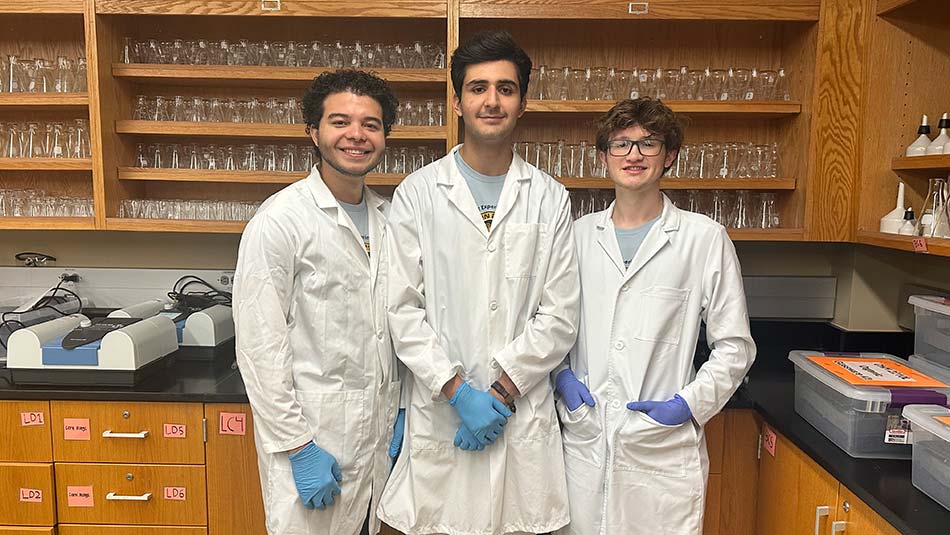
SPC students Vinicio Castillo, Eilya Yazdani and Nicholas Tsongranis
At St. Petersburg College, the path from a lecture hall to a laboratory can lead further than most expect. The College is proud to offer a first look at the SPC team whose work is making its way to the International Space Station (ISS), marking a significant milestone for student-led research.
Sophomores Eilya Yazdani and Vinicio Castillo, alongside early college student Nicholas Tsongranis, have been named the winning team for the Student Spaceflight Experiments Program (SSEP) Mission 21. Selected from a competitive field of 14 other teams at the College, their work was chosen to go up on SpaceX CRS-34 and be conducted on the ISS through this national STEM initiative.
The project, which investigates the formation and properties of calcium alginate hydrogels, seeks to understand how the removal of gravity affects structures used in critical medical and engineering applications. Supported by a $26,000 grant from the SPC Foundation, the team moved beyond standard curriculum into high-level, independent inquiry.
A Launchpad for Success
"Seeing these students transition from learning science to practicing it at a competitive level is exactly why we promote hands-on research at SPC," noted Dr. Grace Moore, Assistant Dean of Natural Sciences and the project’s mentor.
The mission also carries a visual identity born from the SPC community. Through a collaborative "Merging Art and Science" competition, two mission patches were selected to represent the journey. Mark DeRemer, an SPC digital media student and Andrei Popescu, a fourth grader at Gulf Trace Elementary, designed emblems that symbolize the spirit of exploration for this mission.
Through this unique blend of art and experimentation, the SSEP program has offered these students a rare opportunity to connect classroom concepts with real-world applications. By transforming their ideas into a professional-grade research experiment, these young scientists and artists have earned their place as contributors to the future of space exploration.
* The Student Spaceflight Experiments Program [or SSEP] is a program of the National Center for Earth and Space Science Education (NCESSE) in the U.S. and the Arthur C. Clarke Institute for Space Education internationally. It is enabled through a strategic collaboration with Rhodium Scientific, America’s first commercial space biotech company. SSEP is the first pre-college STEM education program that is both a U.S. national initiative and implemented as an on-orbit commercial space endeavor. Research reported herein was supported by the Center for the Advancement of Science in Space, Inc. and NASA under agreement number 80JSC018M0005 and with Rhodium Scientific under agreement number UA-2021-8282. Any opinions, findings, and conclusions or recommendations expressed in this material are those of the author(s) and do not necessarily reflect the views of the National Aeronautics and Space Administration or the Center for the Advancement of Science in Space.